Brain on Donuts
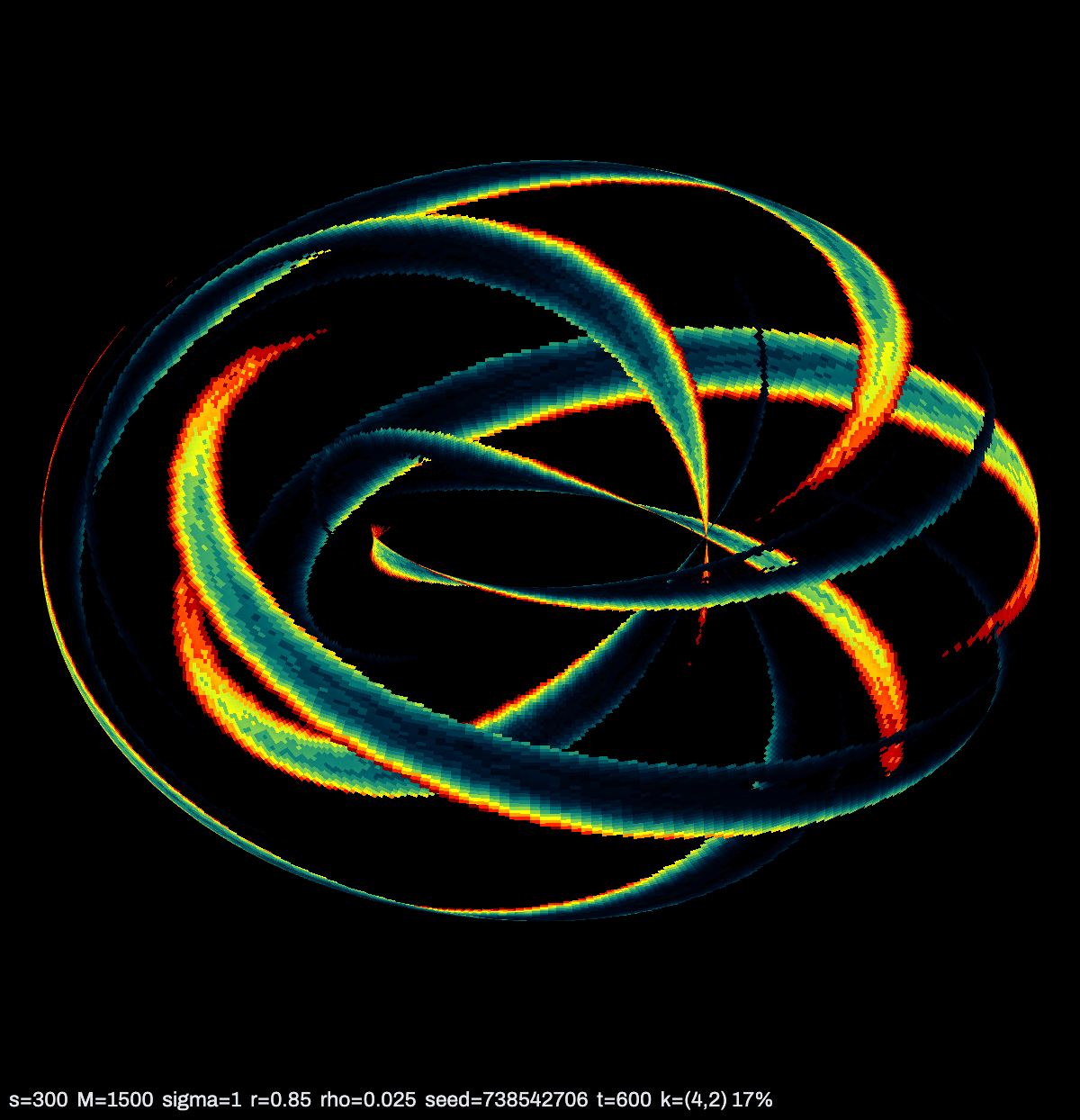
A browser simulation of a place-cell attractor network on a torus, based on a multi-chart path integrator but tuned to produce global traveling waves. You can pick from curated examples or set your own parameters. Watch the activity either on a flat sheet or wrapped onto a 3D donut (i.e. torus) with an optional stereoscopic pair for true 3D visualization.
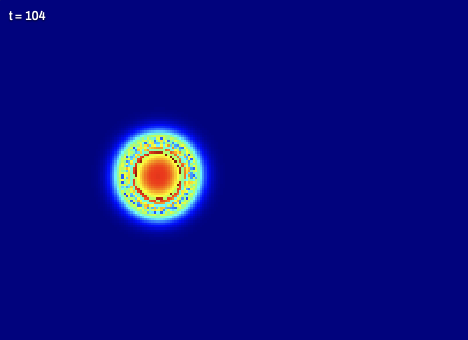
In 1997, Alexei Samsonovich and Bruce McNaughton proposed a model of how a rat's brain keeps track of where the rat is (J. Neurosci. 17:5900). Place cells sit on an imaginary sheet called a chart. Each one excites its neighbors on that chart. The chart is periodic in X and Y, thus able to roll up into a torus (i.e. donut). Inhibition lets only a fixed number fire at once. Typically, the activity collapses into a single bump that represents working memory of where the rat is in space. Nudge the bump and it moves: a continuous attractor.
I ran the same equations with the wrong parameters: slower leak, narrower connections, and a faint web of random long-range wiring to represent other charts. The bump never forms. Instead, wavefronts sweep the donut. What interests me is the dynamical system behavior. 1) Some globally stable patterns are limit cycles, a wavefront circles the torus and returns exactly. 2) Others are chaotic, never converging nor healing when perturbed. 3) Start from noise and the sheet still finds its way to global order, but the path there is chaotic too.